Guide 08 · 5 min read
Why Do Bathroom Remodels Turn Into a Nightmare in Scottsdale, AZ?
Good to know
The scope that was never written
The nightmare starts the same way every time: a reasonable number, a handshake, and a date. Six weeks later the price has doubled, the tile is up, and the ceiling below the shower is staining. This page is about the mechanics of why, and what to check before anyone swings a hammer.
Most bathroom nightmares are not bad workmanship. They are an open-ended remodel: no written scope, no allowance list, no change-order rule. The price grows weekly because the job was priced as a mood instead of a list. The faucet that was included is suddenly an upgrade, the tile that was standard is suddenly special order, and every discovery inside the wall becomes a new invoice.
An allowance list fixes this before it starts. It names the finishes and their budgeted prices before you sign, so the number is a number. A change-order rule fixes the rest: nothing changes without a written price, in advance. Without both, the remodel is a negotiation with a hammer.

Tile and waterproofing
Waterproofing skipped: the leak in year two
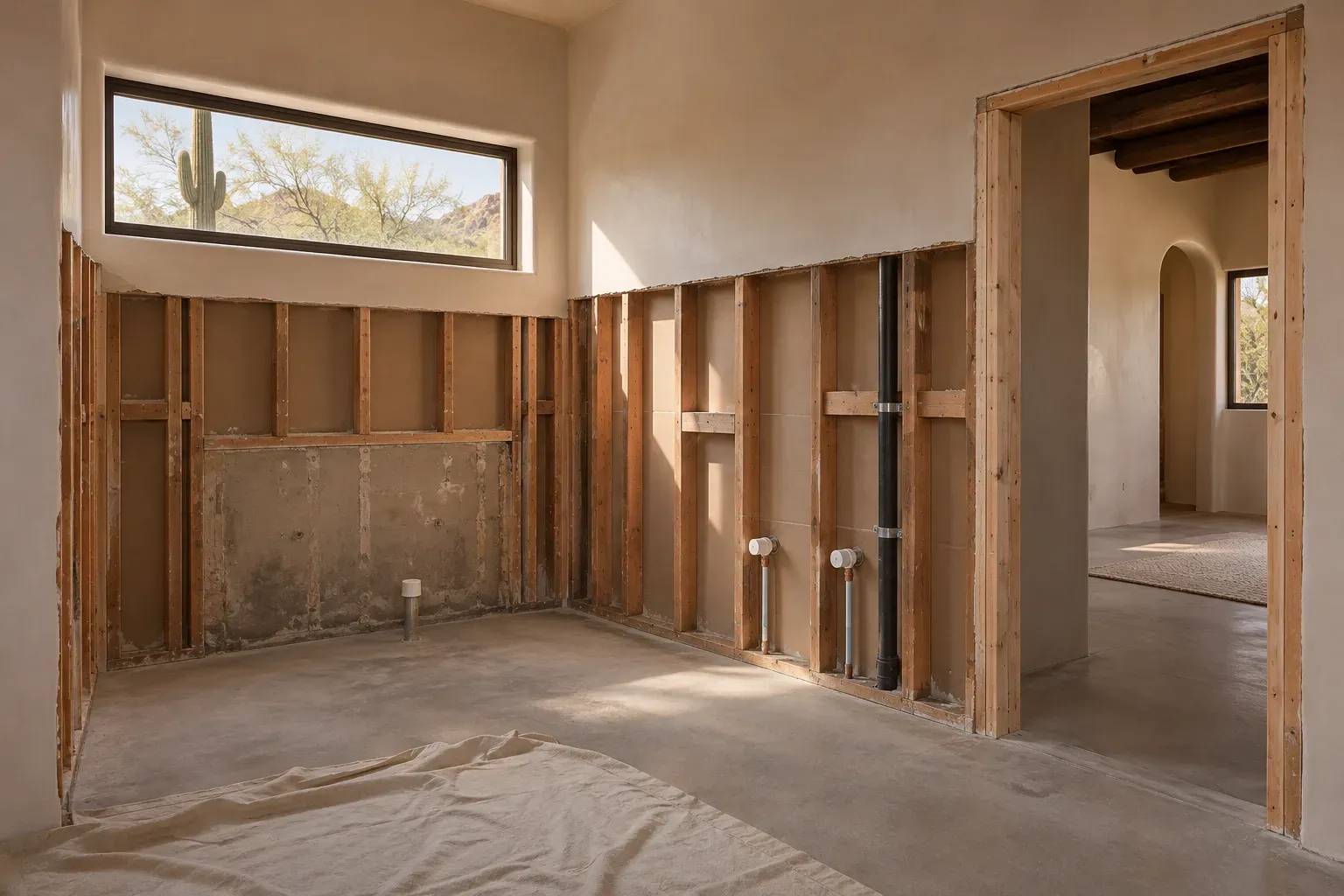
The second nightmare is the one nobody sees for a year or two. Tile goes over greenboard, no pan liner goes in, no flood test gets run, and the shower looks perfect. Water gets behind the tile anyway, because grout is not waterproof and the surface always passes some moisture. With no waterproofing layer behind it, the water meets framing and drywall instead.
The first sign is a stain on the ceiling of the room below, or loose tile at the pan edge, or a smell that will not leave. By then the framing is wet and the fix is not a recaulk, it is a gut. In Scottsdale this hurts more, because the baths are larger and the finishes are high-end, so the gut is bigger and the replacement tile has to match.
Good to know
The trades that blame each other
Nightmare three is the blame relay. The tile work fails and the tile setter says the framing moved. The framing gets checked and the framer says the plumbing leaked first. The plumber says the waterproofing was wrong. The homeowner stands in the middle and pays for each opinion.
The fix is the order of work and one accountable scope. Rough plumbing first, then waterproofing, then a flood test, then tile, then fixtures, then glass. Written down, with the test in the middle, there is no room for a trade to point at the next one, because the sequence decides what was done and in what order.
Good to know
What Scottsdale adds to the nightmare
Scottsdale has its own amplifiers. The water is hard, so polished stone and light grout show scale within a season, and a remodel that specs those materials is pre-stained before the tape comes off the door. The primary baths are large and finished to a high standard, so a mistake costs more to redo, and the redo has to match the rest of the room, which is never on sale.
Some of the worst damage happens in second homes that sit empty through the monsoon. A slow pan leak runs for weeks between visits, and the stain it leaves has traveled farther than it would in a lived-in house. HOA and design review add one more gate when a window, an exterior wall, or a vent changes: approval comes before work, not after, and a remodel that skipped the paperwork becomes a problem at resale in a market where buyers ask.

Good to know
What to check before you sign
- The scope is written, with an allowance list and a change-order rule.
- The waterproofing sequence is named, and the flood test is a line item that happens before tile.
- The trade order is written down, so one crew cannot blame another.
- The finish list has been screened for hard water, and polished stone and light grout got vetoed where the scale is worst.
- The permit is named if a drain or a wall moves, and the HOA question is answered if anything exterior changes.
None of this is expensive to ask for. All of it is expensive to discover later. If the room only needs a lighter touch, the split between a remodel vs refresh is where the scope starts, and the bathroom remodel cost page shows where the money actually goes.
Questions
Questions people ask## Who pays when it goes wrong
Here is the part nobody says out loud: the homeowner pays. The bidder who priced the open scope walks away or stops answering, the next contractor charges more to open someone else's half-finished work, and the insurance route usually ends the same way, because a bad install is not a covered event the way a burst pipe is. The remodel that started as a bathroom becomes an invoice with a bathroom attached.
The second payment is the invisible one: the room you cannot use. A primary bath torn out in a Scottsdale home has no spare next door, so every week of delay is a week of showering in the guest bath or the gym. The third payment is the redo. Tile over greenboard does not get patched, it gets removed, and the second demolition costs more than the first one would have cost to do right, because now there is a finished surface to protect on the way back out.
The pattern repeats on a clock. Weeks one and two go fine, because demo is fast and everyone looks busy. Week three is where the number moves, when the slab is open and the drain is not where the plan assumed. Week four is where the finish questions start, and the allowance list either exists or does not. The homeowners who describe the nightmare almost always describe the same week three, which is the week the written scope was supposed to be working.
Scottsdale makes week three worse. The plumbing is in slab, so every change is a concrete cut. The finishes are high-end, so every substitution is a special order. And the second home is the cruelest version: the work happens in the empty months, the owner is not there to see week three happen, and the first report of trouble is the stain, not the change order.
None of this is a secret. The scope was open, the waterproofing was skipped, the test was never scheduled, and each of those is visible on paper before the work starts, if anyone looks. The nightmare survives on one thing: nobody asks to see the list. The list costs nothing to produce, and its absence costs everything else.
Our bathroom remodeling page shows what a full project involves.

6 questions
Why Do Bathroom Remodels Turn Into a Nightmare: your questions
Still have a question? Call (602) 782-5702 and describe the bathroom.
Why does a bathroom remodel cost more than the quote?
Because the scope was open. Allowances were not written, changes were not priced in advance, and each discovery became an invoice. A written scope with a change-order rule stops the growth.
What is a flood test and why does it matter?
The drain gets plugged, the pan gets filled, and the water has to hold before tile goes up. It is the only proof the shower does not leak, and it happens before the finish, never after. The full story is on the flood test nobody runs.
How long should a bathroom remodel take?
It follows the sequence: demo, plumbing, waterproofing, flood test, cure, tile, fixtures, glass. Each step takes its share, and a schedule that skips a step is a schedule hiding something.
Why did my new shower leak after two years?
Almost always the waterproofing. Tile over greenboard, no pan liner, no flood test. The surface looked right while the framing behind it went soft.
Do I need a permit for a bathroom remodel in Scottsdale?
When a drain moves or a wall changes, yes, and skipping it surfaces at resale. Interior finishes alone usually do not.
What should I do with a second home remodel?
Schedule it so the shower is not left mid-job through the monsoon, and have someone check the empty house between visits, because a leak in a closed house has weeks to run.